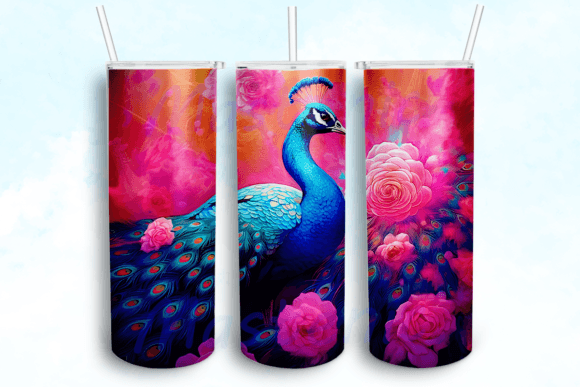
Peacock 20 Oz Skinny Tumbler Sublimation
A Designer’s First Glance: Grace, Not Gimmick
When I opened Peacock 20 Oz Skinny Tumbler Sublimation, I didn’t see a “trendy” clipart bird—I saw rhythm. The curve of the tail feathers echoes the lean silhouette of a 20 oz skinny tumbler, and the composition breathes with intentional negative space. It’s not overly detailed, but it’s not simplified into abstraction either. That balance matters—especially when translating a sublimation graphic into machine embroidery design territory. As someone who regularly adapts digital graphics for stitch, I immediately asked: *Where does this live beyond the tumbler?*
Real-World Test: Embroidering a Linen Tote for a Local Boutique
Last week, I used Peacock 20 Oz Skinny Tumbler Sublimation as inspiration for a custom embroidered linen tote—part of a small-batch collection for a downtown gift shop. I traced the core peacock motif (not the full tumbler layout), resized it to 3.5" wide, and digitized a clean satin-stitch outline with subtle fill-stitch texture in the fan. Customers responded instantly—not just to the imagery, but to how *resolved* it felt. No visual clutter. No awkward tapering that fights fabric grain. That clarity comes from the original’s smart proportions: the tapered PNG file especially gave me confidence scaling down for smaller hoop sizes without losing legibility.
Where This Design Earns Its Keep
- Custom apparel: Works beautifully on sweatshirt sleeves or chest placements—its vertical flow complements knit structure without pulling or distorting.
- Embroidered patch: Clean outer edges mean crisp heat-applied or sewn-on patches, even at 2.75".
- Baby embroidery: Soft curves and no sharp micro-details make it ideal for onesies or burp cloths—no snag risk, no frustration during hooping.
- Holiday embroidery & wedding gifts: Feels special without being ornate—perfect for monogrammed tea towels or guestbook covers where elegance reads quietly.
- Craft business & Etsy seller: The dual PNG formats (straight + tapered) let you mock up both flat goods and curved surfaces fast—critical when prepping listings or client proofs.
Where to Pause—and Plan Ahead
Peacock 20 Oz Skinny Tumbler Sublimation isn’t magic dust. It’s a strong starting point—but real embroidery demands real prep. Here’s what I watched for:
- Small hoop sizes: The straight PNG fits neatly in a 4x4 hoop if centered, but avoid cramming the full tapered version into anything under 5x7 without simplifying feather layers.
- Textured fabrics: On bouclé or heavy linen, I added lightweight tear-away stabilizer beneath and topped with a light film to keep satin stitches smooth.
- Thin or stretchy fabric: For baby onesies or lightweight tees, skip dense fill areas—opt instead for open-outline versions or running-stitch interpretations.
- Dark fabric: The design’s mid-tone contrast works best on light-to-medium backgrounds. On charcoal or navy, I tested thread colors first—navy-blue thread with silver metallic accent stitching kept it rich but readable.
- Curved surfaces (caps, mugs, tumblers): Yes, it was made for tumblers—but remember: sublimation ≠ embroidery. If stitching on a curved surface like a cap visor, use the tapered PNG as a guide, then re-digitize for stitch direction and tension control.
What It Adds to Your Finished Product—Beyond Aesthetics
This isn’t just about prettiness. Peacock 20 Oz Skinny Tumbler Sublimation elevates perceived value because it feels *designed*, not dropped in. When customers see that deliberate curve echoing the product shape—or recognize how cleanly it scales across tote bags, pillow covers, and aprons—they trust your eye. That trust converts: Etsy sellers tell me repeat buyers cite “consistency” as their top reason for coming back. It also supports brand cohesion—whether you’re building a nature-inspired craft business or launching a line of personalized gifts, this motif carries quiet sophistication without shouting.
Practical Notes Every Embroidery Designer Should Run Through
- Test the design on scrap fabric *first*—especially if using layered stabilizers or metallic threads.
- Check thread color contrast on both light and dark fabric swatches before stitching the final piece.
- Review stitch density: high-fill areas may need reduced density on knits or delicate weaves.
- Confirm your hoop size matches the intended placement—don’t assume the tapered PNG will fit your cap frame without adjustment.
- Inspect small details at actual stitch size: those delicate feather tips can vanish if scaled too small or stitched too densely.
- Try a black-and-white mockup—it reveals value shifts and hierarchy faster than color ever will.
- Use proper stabilizer: cutaway for knits, tear-away for stable wovens, and always test wash one sample to check for puckering or thread wear.
- Verify licensing: since this is a digital embroidery file sold as a Graphics asset, confirm whether commercial use (e.g., selling finished embroidered totes) is permitted before listing on Etsy or at craft fairs.
Final Thought: A Quiet Workhorse, Not a Flash-in-the-Pan
I don’t reach for Peacock 20 Oz Skinny Tumbler Sublimation when I need fireworks. I reach for it when I need grace under pressure—when a client wants something meaningful but not fussy, when my craft business needs cohesive design assets across categories, or when I’m stitching a holiday gift that has to feel handmade *and* intentional. It’s the kind of embroidery file that disappears into the product while making everything around it look more considered. In a world of oversaturated motifs and rushed digital downloads, that kind of restraint is rare—and deeply useful.